Launch of child friendly report at a webinar on 21 October |
| | |
| Update on child and youth policy and practice 5/2026 | | | | | | | |
Launch of child friendly report in six Nordic languages on children’s right to be heard
|
The report Participation is protection –
embedding children’s rights in Nordic crisis governance,
emphasises the importance of including children and young people in emergency
preparedness work and decision-making processes that affect them. The Nordic
Welfare Centre collaborates with the Nordic Ombudsmen for Children to produce
child-friendly versions of the report in Danish, Finnish, Greenlandic,
Icelandic, Norwegian and Swedish. The reports will be launched at a webinar on
21 October. |
| | |
Launch of reports on digital democracy for children and young people
| Two reports
analysing the impact of digital media on children and young people will be
presented at a webinar. Joint Nordic recommendations will be developed based on
the research findings presented and on upcoming stakeholder consultations.
Join us at
the webinar where the researchers involved will present a literature review, a
mapping of policies and measures in the Nordic countries, as well as young
people’s own views on the issue. The presentations will be followed by a
discussion on the conclusions and recommendations presented. | | | | |
New research network on children at risk of poverty and social exclusion
| The Nordic
countries share a welfare model built on the principle that all children should
have equal opportunities. Yet some children grow up in households with
persistently low incomes. Compared with their peers, they face a greater risk
of poor material living conditions and health problems, as well as weaker
engagement with education and later working life.
The network
is currently in its development phase. During this initial stage, the ambition
is to connect research communities across the Nordic region, map existing work
in each country, and identify the areas where Nordic co-operation can add the
greatest value. The network welcomes new members! | | | | | We are hiring! Join our team working on children and young people | Our colleague
Merethe Løberg returns to her position as senior adviser at The Norwegian Ministry of Children and Families after more than
seven years at the Nordic Welfare Centre. As a Senior Adviser, you will play a
key role in developing, coordinating and disseminating knowledge that
strengthens welfare, support measures and services for children and young
people across the Nordic region. You will also help create opportunities for
mutual learning between countries and contribute to establishing Nordic
platforms for dialogue, networks and collaborative projects. The position is
based in Stockholm. Apply, in any Scandinavian language, by 30 October. | | | | |
Update on our project on inclusive education for children with disabilities
| In
September 2026, the Nordic Welfare Centre and the Research Group on Disability
and Inclusion at the University of South-Eastern Norway signed
a co-operation agreement on research on inclusive education for children with
disabilities.
The
research will result in a knowledge compilation on inclusive education for
children with disabilities in the Nordic region, with a specific focus on
preschool and obligatory primary education, and proposals for how this can be
improved.
The
research focuses on the Nordic countries participating in the project: Denmark,
Finland, the Faroe Islands, Greenland, Iceland, Norway, Sweden and the Åland
Islands.
The
knowledge compilation will be published in autumn 2027. The findings will be
presented at a seminar/webinar, and to the Nordic Council of Ministers. | | | | |
Updates from the Nordic network about the child’s first 1000 days – a healthy start in life
| | | On 1—2
September, the Nordic Mental Health Summit 2026, organised by the Danish Health
Authority, brought together participants from the Nordic-Baltic countries to
discuss mental health and well-being among children and young people.
At the Summit, the Nordic Network, represented by Sigrún Daníelsdóttir and Jenný Ingudóttir of the Directorate of Health in Iceland, presented the 1000 Days Project and its policy recommendations, as well as findings from the report: The First 1000 Days in the Nordic Countries - Identifying Gaps and needs to Strengthen Psychosocial Well-being.
On 3—4 September,
the Nordic network held
its annual in-person meeting, hosted by the Danish Health Authority (the
current chair of the network). The meeting provided an opportunity to share
knowledge and experiences on how the Nordic countries can better support young
children and families and adapt this support to different needs. | | | | |
Inequities in services and gaps in support for expectant parents and families with young children
| Parents’
mental health during pregnancy and the first years of a child’s life is crucial
for the child’s development and long-term mental and physical health and
well-being. However, despite a strong evidence base regarding risk and
protective factors, access to support varies both geographically and between
population groups across the Nordic countries. The implementation of
evidence-based methods is progressing slowly, partly due to high costs and a
lack of expertise. These findings are highlighted in a recently published
report that was discussed during events at SuomiAreena and Arendalsuka this
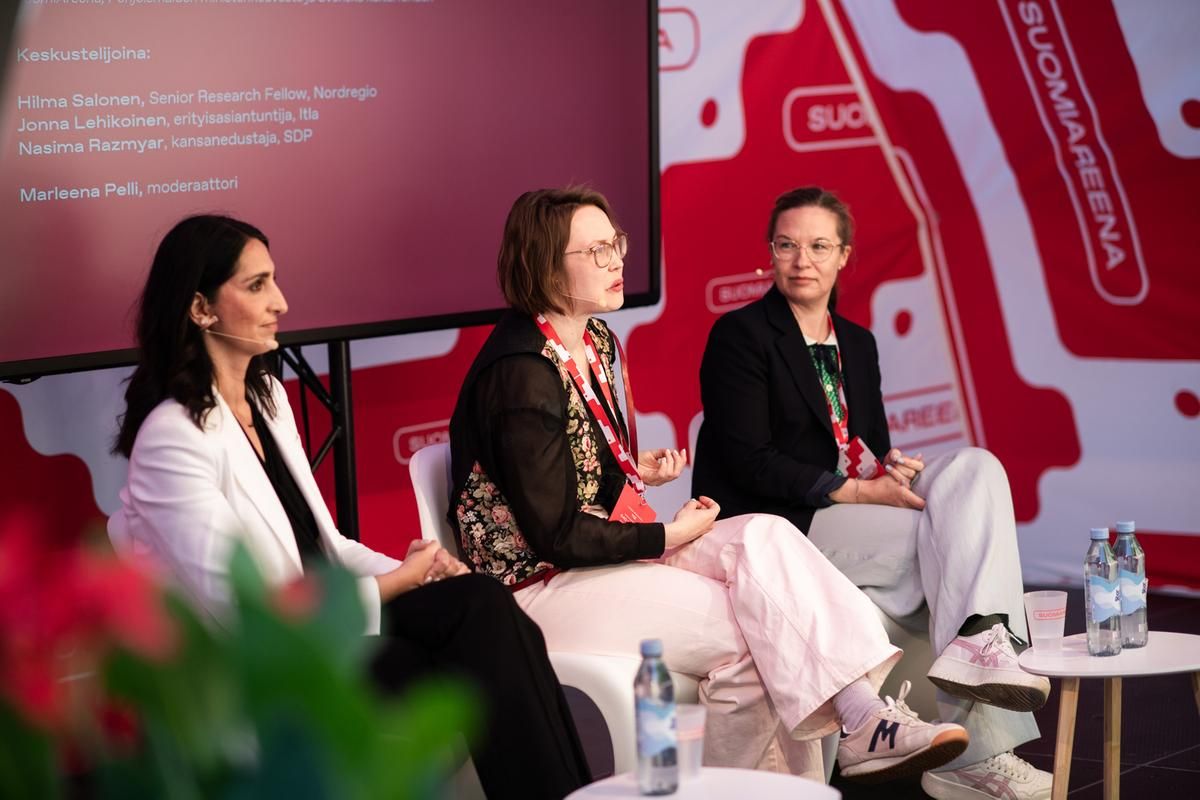
summer. Photo: Laura Karlin | | | | |
‘Children’s participation is protection’ – Nordic Welfare Centre at European crisis conference
| When a crisis strikes, it is crucial that children and young people are heard. This was the key message delivered by Senior Adviser Merethe Løberg at the European Social Network’s (ESN) annual seminar on crisis management in Helsinki on 24 September.
Løberg took part in the plenary session Protecting vulnerable populations in crises, alongside speakers from Spain, the UK and Greece. There, she presented findings from the report Participation is Protection: Embedding Children’s Rights in Nordic Crisis Governance, produced by the Nordic Welfare Centre in collaboration with the Nordic Ombudsmen for Children and Professor Emerita Kirsten Sandberg, former leader of the UN child rights committee.
The report examines how the Nordic countries are implementing Article 12 of the UN Convention on the Rights of the Child – the right of children to be heard – during and after crises. The picture is mixed. There are good examples, such as a Danish youth panel whose input led to concrete changes. However, children’s voices were often missing when decisions had to be made quickly, and the consequences are still being felt. 'Decisions taken in the best interests of the child without the child’s involvement is a decision based on an assumption,' said Løberg. She highlighted child impact assessments as a practical tool for incorporating children’s perspectives into contingency planning. | | | | | Take a look at our new website! | We have
upgraded our website in terms of functionality, accessibility, and content. The
website is available in two language versions: an English version and one
featuring content in the Scandinavian languages. Take a look around and explore
the site's new structure and content. | | | | | Did you get this newsletter forwarded to you? Subscribe here! | This
newsletter is published about six times a year, mainly in English, with
occasional Scandinavian articles. It contains the latest news about our
network, projects and publications, and information about coming events in the
field of child and youth policy and practice in the Nordic region. | | | | | | | |
Norden ska vara världens mest hållbara och integrerade region år 2030. Nordens välfärdscenter bidrar framför allt till målet om ett socialt hållbart Norden. Läs mer om arbetet i Nordiska ministerrådets Vision 2030.
|
| | |
|
|